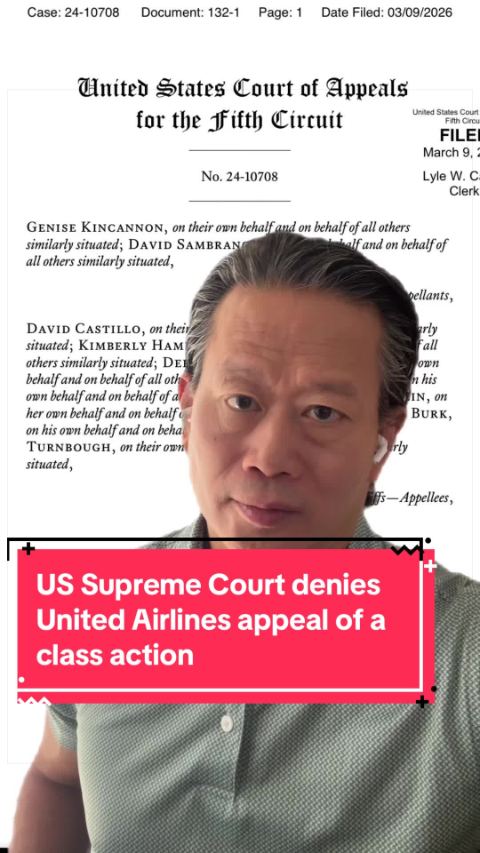
Update: The video caption describes United as having successfully appealed. The court records show something different. The Fifth Circuit affirmed class certification on March 9, 2026, and United then asked the U.S. Supreme Court to review that ruling. MLex has reported that the Supreme Court declined to review it, which leaves the Fifth Circuit’s ruling in place. That does not decide whether United is liable. It means the religious-accommodation claims can continue as a class action.
Class actions let employees with similar claims pursue them together, which can level the playing field against a large employer. A recent Fifth Circuit decision involving United Airlines is a useful example of how courts treat group claims in employment cases.
What happened
In August 2021, United Airlines adopted a COVID-19 vaccine mandate. Employees who asked for religious accommodations alleged they were placed on indefinite unpaid leave instead of being reasonably accommodated. A federal district court in Texas certified a narrow subclass of customer-facing employees who sought religious accommodations and were accommodated with unpaid leave. It declined to certify a broader group.
The Fifth Circuit’s decision
On March 9, 2026, the Fifth Circuit Court of Appeals affirmed the certification, finding the district court did not abuse its discretion. United had argued that a court would have to examine the sincerity of each employee’s religious beliefs. The panel majority concluded that common questions about the airline’s accommodation policy could be answered for the group as a whole. United has since asked the U.S. Supreme Court to review the decision, so the story may not be over.
Why this matters to workers
Title VII of the Civil Rights Act requires employers to reasonably accommodate sincerely held religious beliefs unless doing so would cause undue hardship. Class certification can make it practical to challenge a company-wide policy when each worker’s individual damages might be too small to justify a separate lawsuit.
- Put accommodation requests in writing and keep copies.
- Save the employer’s response, including any notice about leave or pay.
- Ask about deadlines for filing a charge with the EEOC.
Whether the issue is religion, disability, unpaid wages or overtime, an employment lawyer can explain whether your claim might be brought alone or with coworkers.
Want more quick legal updates for workers? Follow @overtimelawyer on TikTok.
This article is general information, not legal advice. Every case depends on its own facts, so talk to an employment lawyer about your situation.
Watch the video
Watch on TikTok @overtimelawyer
Additional Resources:
- Fifth Circuit opinion in the United Airlines appeal (ca5.uscourts.gov)
- Title VII religious discrimination, 42 U.S.C. section 2000e-2 on Cornell LII
- MLex: High Court Won’t Review United Challenge To Vax Bias Class (subscription may be required)
- Fifth Circuit opinion on FindLaw
- United’s petition for certiorari, No. 26-183 (supremecourt.gov)
